
About Elena Ocone
A lifelong inquiry into consciousness, perception and change, carried through classical philology, Tibetan Buddhism, Traditional Chinese Medicine and thirty years of practice with the Yi Jing.
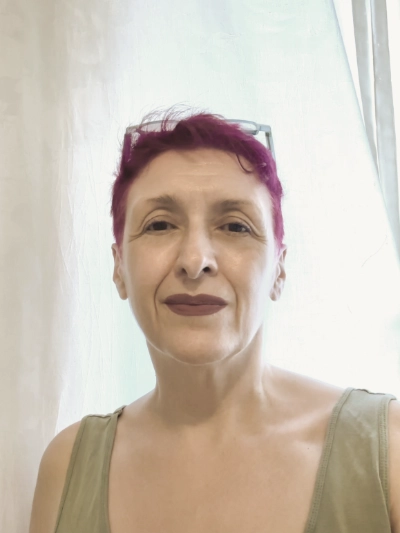
Elena Ocone’s formation began with the classical humanities. Educated at the Liceo classico Arnaldo in Brescia and at the University of Verona, where they studied foreign languages and literatures with a philological focus, EO received the kind of training that teaches you to examine a text carefully, situate it in its tradition, find resonances with other works and cultures but resist the temptation of easy equivalences. That discipline has shaped everything that followed.
The Eastern work began in 1987 with Tibetan Buddhism, with four years of intensive study and retreat practice with Tibetan and Western teachers across Italy, Switzerland, Belgium, and Great Britain. It was a rigorous encounter with a tradition that takes the structure of consciousness as an object of systematic inquiry, and it gave them the inner framework within which the subsequent practice in Chinese disciplines would eventually settle.
EO came to Qigong and Tai Ji Quan in 1991, and between 1992 and 1997 lived primarily in Asia — in China, Thailand, Indonesia, Cambodia, Hong Kong, and Singapore — studying Taoist and Buddhist Qigong alongside yogic and contemplative disciplines across several traditions.
The institutional centre of this period was the Shandong College of Traditional Chinese Medicine in Jinan, where in 1995 EO completed the Advanced Study Certificate — the equivalent of a university degree in Acupuncture, Tuina, and Herbal Medicine — with 1,400 hours of study and clinical practice at the affiliated hospital. Their personal tutor was Professor Mu Jianhua. Through Professor Guan Zhen, a researcher at the College, EO became a student in the lineage of Professor Bi Yong Shen, one of the most influential figures in Taoist Therapeutic Qigong.
Alongside the TCM formation, in 1999 EO studied the Jing Gan Li Gong — the Vajra or Diamond Qigong — with Master Yu Xiang Hua in Liaocheng, the 23rd lineage holder of a tradition specialising in the internal techniques of Martial Qigong known as the Steel Body methods.
From 1993 to 2010 EO were a direct student of Professor Jiang Zhou Cun, Director of Physical Education at Shandong Teachers’ University, with whom they studied Kung Fu Internal Styles: Yang and Chen Tai Ji Quan, Ba Gua Zhang, and Xing Yi Quan.
Returning to Italy in 1997, EO began teaching Qigong and Tai Ji Quan in Brescia, in private studios and through the municipal sports promotion programme of the Comune di Brescia. From 1998 to 2010 they also organised study trips to China and Thailand, and invited distinguished masters of Traditional Kung Fu to teach intensive residencies in Italy.
EO developed a programme for fall prevention in the elderly, using techniques and movement sequences from the Internal Styles to rebuild proprioception, improve circulation, and restore balance, successfully piloted at the Centro Anziani of the Comune di Gussago.
In 2012 EO returned to Bangkok to complete the Traditional Thai Massage Certificate in Ruesi Datton — the yoga of the Thai forest hermits — at the Chetawan School of Wat Po, the originating institution of Thai traditional medicine.
EO were recognised as Maestro Caposcuola of Qigong by both the PWKA-MSP-CONI (1997) and the national CSEN-CONI (2012), the highest Italian federal teaching qualifications in this discipline.
EO’s teaching has always been structured as a path rather than a collection of techniques. The published booklets — covering foundational practices from Dantian cultivation and breath work through to the Five Phases — represent the preliminary layer of this path: the somatic and energetic preparation without which the subtler work cannot deliver its due results.
Since 2022, EO has been working with a small group of longtime students at the next level: the principles of Daoist Internal Alchemy as illustrated in the Xiuzhen Tu — the Diagram of the Cultivation of Perfection — and the practice of the the Microcosmic Orbit integrated within the visualisation framework of the Neijing Tu, the Diagram of the Internal Landscape. The teaching materials from this work, alongside those from the Yi Jing sessions of recent years, are currently being collected and prepared for publication.
Since 1995, grounding their work in the teaching of Professor Bi Yong Shen and Professor Guan Zhen and through a comparative study of Western Iatromathematics and Taoist Alchemical thought, EO have applied themselves to the Yi Jing as ritual and meditative practice and as an instrument for psychological self-analysis and inner development. Sustained over thirty years and developed through years of weekly group sessions with students, this inquiry is the intellectual foundation of the Yi Jing consultancy EO now offer, and the subject of a body of writing currently in preparation.
From 2014 to 2020 EO conducted a series of public seminars exploring the intersection of Buddhist epistemology and the neuroscience of perception. The seminars took as their starting point a structural convergence: both Buddhist analysis and contemporary cognitive science describe ordinary perception not as a transparent window onto reality but as a constructive process heavily influenced by past experiences. EO developed a method to investigate this process using the traditional black mirror as a practical device that makes what Buddhist tradition calls the Ego’s illusion directly observable. This convergence is not incidental to the Qigong teaching: the same theoretical ground underlies the work on visualisation and subtle body perception that forms the bridge between foundational Qigong practice and Nei Dan.
The Western esoteric thread has run alongside all of this from the beginning. Rooted in their classical humanities training, EO’s study of Western Alchemy — from the Corpus Hermeticum to Rosicrucian Kabbalah — provides a symbolic vocabulary that helps them conveying the Eastern concepts to the western public. Their synthesis integrates Taoist Alchemy and TCM, Tibetan rigorous epistemological analysis, and Western Hermetic philosophy not as an eclectic mixture but as a coherent triple perspective on the same fundamental inquiry: the nature of consciousness, the dynamics of perception, and the proven methods that can help deepen and expand our awareness.
EO founded the Ars Magna Association for Intercultural Research and Study in Brescia in 2012, through which they taught and published until its closure in 2025. They now teach privately and conduct their work — Qigong and Nei Dan instruction, Yi Jing consultancy, and writing — through The Changes Space.